
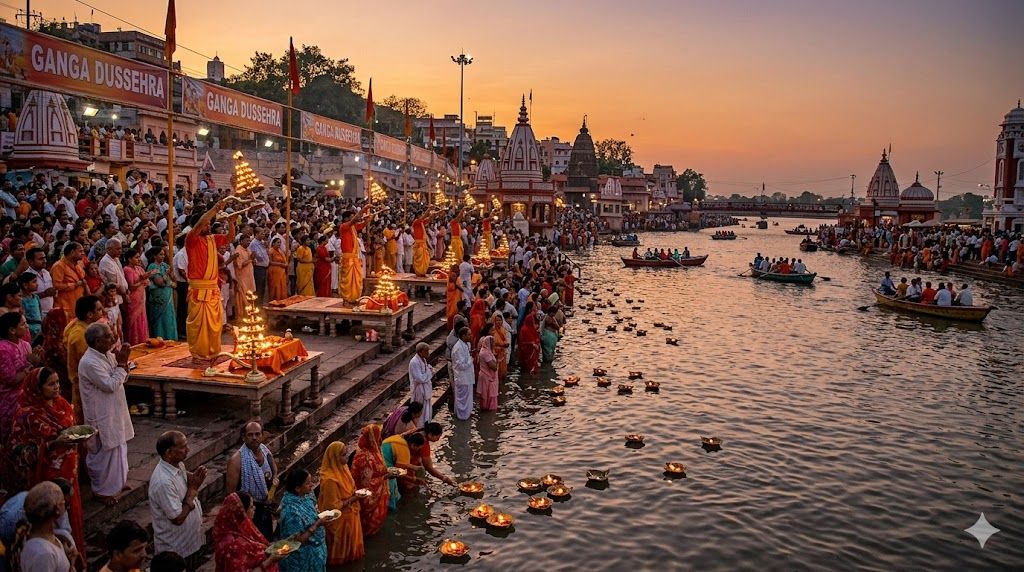
Ganga Dussehra is a Hindu festival celebrated to mark the day when the Holy River Ganga descended upon the Earth. It falls on the tenth day of the bright fortnight, that is, during the Dashami Tithi of Jyeshtha Shukla Paksha (Waxing Moon Period), and this year it falls in the month of May. Ganga Dussehra is also known as Gangavataran, which means the descent of the Ganga.
The festival is primarily celebrated in Northern India, especially in the states of Uttar Pradesh, Uttarakhand, and Bihar, where the river Ganga flows. Devotees take a dip in the holy river, perform puja (worship), and offer prayers to Mata Ganga for purity and blessings.
It is believed that by taking a dip in the river Ganges on this day, you can wash away all sins and bring salvation. The festival is also significant for those who believe in astrology, as it is said that the positions of the planets on this day have a positive influence on human life.
So, let’s get to know more about the Date, Rituals, and Significance of Ganga Dussehra 2026.
Ganga Dussehra 2026: Date, Muhurat, and Timings
This year, Ganga Dussehra will be observed on Monday, May 25, 2026
- Dashami Tithi Starts: 04:30 a.m. on May 25, 2026
- Dashami Tithi Ends: 05:10 a.m. on May 26, 2026
- Hasta Nakshatra Starts: 04:08 a.m. on May 26, 2026
- Hasta Nakshatra Ends: 05:56 a.m. on May 27, 2026
- Vyatipata Yoga Starts: 03:11 a.m. on May 27, 2026
- Vyatipata Yoga Ends: 03:25 a.m. on May 28, 2026
Find Out Date and Muhurat of Mohini Ekadashi 2026
Significance of Chaitra Purnima
Ganga Dussehra, one of the important festivals for Hindus, holds great significance for the people who live along the banks of the river Ganga. So, let’s find some of the reasons why this festival is considered important.
Descent of the River Ganga
According to Hindu mythology, Ganga descended from the heavens to the earth on the day of Ganga Dussehra. It is believed that taking a dip in the holy river on this day can purify the soul and wash away all sins.
Astrological Significance
Ganga Dussehra is also believed to be an auspicious day for those who follow astrology. It is said that the alignment of planets on this day brings a positive impact on the lives of people. It is said that participating in the Ganga Aarti and offering donations to Brahmins or needy people helps remove the bad karma effect.
Agricultural Significance
The festival is also significant for farmers, as it marks the beginning of the sowing season in many parts of India. The arrival of the monsoon season is closely linked to the festival, and farmers believe that performing puja on this day can bring good rains and a bountiful harvest.
Cultural Importance
Ganga Dussehra is an important cultural festival in many parts of India, especially in the northern states. It is celebrated with great enthusiasm, and people come together to take a dip in the river, perform puja, and offer prayers to Goddess Ganga. It is also regarded as an auspicious day to purchase a new house property, vehicle, or make investments, etc. On this day, it is also auspicious for moving to a new house.
Overall, Ganga Dussehra is a significant festival that celebrates the descent of the holy river Ganga and holds great cultural significance for the people of India.
Also Know: What is Ganga Saptami and Its Importance?
Ganga Saptami 2026 Rituals
On the day of Ganga Dussehra, there are several rituals that are traditionally followed by the devotees. Let’s find some of the common rituals associated with Ganga Dussehra that you can follow on this day and offer your prayers to Maa Ganga.
- Taking a Holy Dip: One of the most important rituals of Ganga Dussehra is taking a dip in the holy river Ganga. It is believed that taking a dip in the river on this day can purify the soul and wash away all sins.
- Offering Prayers: People visit the banks of the river and offer prayers to Goddess Ganga. They light diyas (lamps), participate in Deep Daan, and offer flowers and sweets as a part of the puja (worship).
- Fasting: Many devotees observe a fast on Ganga Dussehra. Some people fast throughout the day, while others fast until they take a dip in the river.
Also Read: Importance of Fasting on Religious Festivals
- Donating: It is considered auspicious to donate food, clothes, or money to the poor and needy on Ganga Dussehra.
- Reciting Mantras: Many people recite mantras dedicated to Maa Ganga, such as the Ganga Stotram or the Ganga Chalisa.
- Visiting Temples: Devotees also visit temples dedicated to Goddess Ganga on this day and seek Maa Ganga’s blessings.
Hence, the rituals of Ganga Dussehra are centred around worshipping Maa Ganga and seeking her blessings for the purification of the soul and a happy and prosperous life.
Mythological Legend Behind Ganga Dussehra
Let’s find here the mythological legend behind Ganga Dussehra
According to Hindu mythology and scriptures, there was a King named Sagara who ruled the Suryavansha dynasty during the Satya Yuga. King Sagara once performed the Ashwamedha Yagya to demonstrate his sovereignty. Lord Indra, fearing the outcomes of this yagya, stole the horses of the ceremony and left them in the hermitage of Sage Kapila. When King Sagara and his sons learned about the missing horses, they mistakenly accused Sage Kapila and planned to attack him in anger. But, before they attacked the sage, he cursed them, and as a result, all of them were burnt.
Sage Kapila then returned the horses to King Sagara’s grandson, Ayushman. On the request of King Ayushman to liberate his ancestors from the curse, Sage Kapila informed him that the curse could only be lifted if Mata Ganga descended to Earth and purified their souls with her divine water. Bhagirath, one of the successors to the King, performed penance to seek the help of the deities and to purify the souls of his forefathers. Pleased with his penance, Lord Brahma assured King Bhagirath that Goddess Maa Ganga would come to Earth to help him.
However, the surge of the Ganga was so powerful that it could destroy the Earth. Lord Brahma instructed Bhagirath to request Lord Shiva to release the river from his hair, as only he could control the flow of the Ganga. With devotion, dedication, and penance, Bhagirath convinced Lord Shiva to release Ganga. Thus, the holy river was released, and the river purified the souls of his forefathers.
Hence, the day on which River Ganga descended to the Earth from heaven is celebrated as Ganga Dussehra. And, the day on which Bhagiratha’s prayers and penance were answered by Lord Brahma is celebrated as Ganga Saptami. It is believed that by taking a dip in the holy river Ganga on Ganga Dussehra as well as on Ganga Saptami, one can purify their sins and attain salvation.