
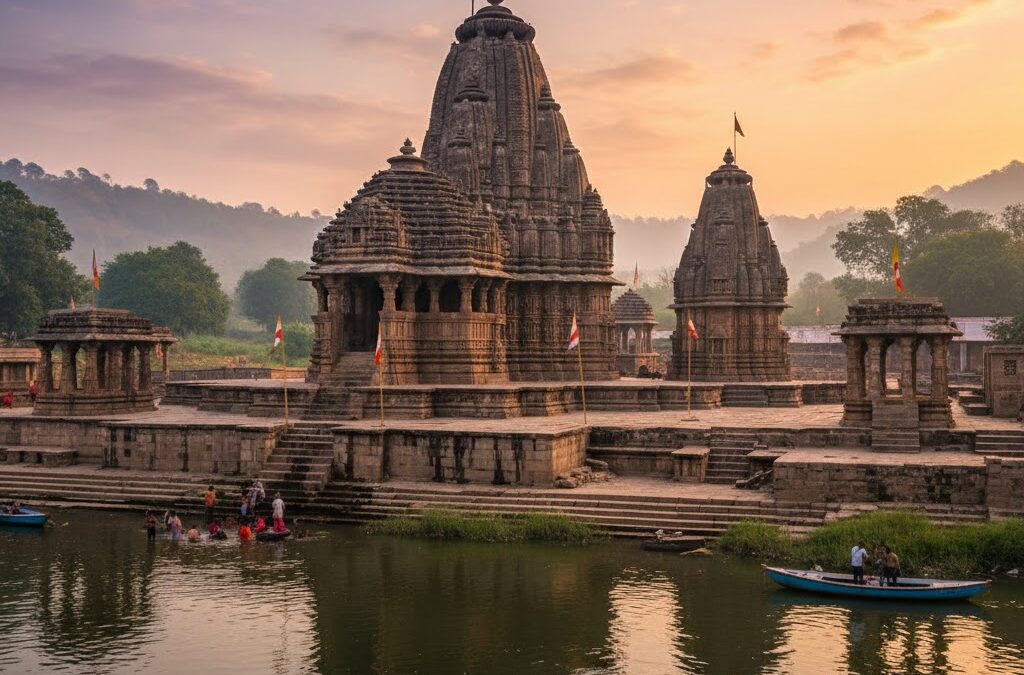
Mamleshwar Jyotirlinga
Mamleshwar Temple, one of the twelve Jyotirlinga temples situated in India, is located on the naturally ‘Om-shaped’ island of Mandhata or Shivpuri, on the banks of the river Narmada in Khandwa district of Madhya Pradesh, India. As it is one of the 12 Jyotirlingas, it is specially dedicated to the worship of Lord Mahadev.
Mamaleshwar temple, situated on the banks of the river Narmada, is also known as Amareshwar temple during ancient times. In literal terms, Amareshwar means ‘Lord of Immortals’, and is located on the south bank of the river Narmada, opposite the Omkareshwar temple.
Mamleshwar temple is believed to have been here for thousands of years and is mentioned in various sacred texts of Sanatan Dharma. The present structure of the ancient temple was built in the 10th century. It is highly famous across India for its majestic architecture, history, and mainly due to being a Jyotirlinga.
Temple History of Mamleshwar Jyotirlinga
Mamleshwar Jyotirlinga is another important temple dedicated to Lord Shiva, located in the ancient town of Maheshwar in Madhya Pradesh, India. The temple has a rich history dating back to ancient times, and there are several legends associated with it.
According to one legend, once upon a time, there was a demon named Raktavija who had a boon that he could reproduce himself every time a drop of his blood fell to the ground. The demon wreaked havoc in the world, and the Devas (celestial beings) were unable to defeat him. They sought the help of Lord Shiva, who appeared on the scene and consumed the demon’s blood before it could fall to the ground. This act destroyed the demon, and the Devas were able to regain control of the world. The spot where Lord Shiva consumed the demon’s blood is believed to be the site of the Mamleshwar Jyotirlinga temple.
Another legend says that once upon a time, there was a great king named Sahasrarjun who ruled over the kingdom of Mahishmati. He was a devout follower of Lord Shiva and performed severe penance to please the Lord. Pleased with the king’s devotion, Lord Shiva appeared before him and blessed him with a boon. The king asked the Lord to reside in his kingdom, and Lord Shiva granted his wish by manifesting as the Mamleshwar Jyotirlinga.
The temple complex of Mamleshwar Jyotirlinga comprises several shrines dedicated to Lord Shiva, including the main shrine of Mamleshwar, which is considered to be the Jyotirlinga. The temple has undergone several renovations and restorations over the years, and it is considered to be an important pilgrimage site for devotees of Lord Shiva.
The town of Maheshwar, where the temple is located, is also famous for its handloom sarees and other textiles. The town has a rich history and cultural heritage, and it is a popular tourist destination in Madhya Pradesh.
Importance of Mamleshwar Mandir
Jyotirlinga Mamleshwar, Omkareshwar, is one of the 12 Jyotirlingas dedicated to Lord Shiva. It is also popularly called the Amreshwar Temple. The temple is located on the banks of the Narmada River in Madhya Pradesh. A visit to the Jyotirlinga Mamleshwar, Omkareshwar, is incomplete without a Parikrama around the Om-shaped island in the Narmada River. It is believed that even Shri Ram performed the Rudrabhishek Puja of Parthiv Shivalinga here before marching on the war against Demon King Ravana.
Another legend says that in order to be more powerful than Surya Dev, Shani Dev also performed the Rudrabhishek Puja of Parthiv Shivalinga here to please Lord Shiva.
There are various legends associated with Jyotirlinga Mamleshwar. According to one of the legends, the Pandavas built a Shiva Lingam during their exile in the Mahabharata era. That Lingam is known as Mamleshwar. Another popular belief is that the existence of Mamleshwar Jyotirlinga can be connected to the Vedic times, when Lord Shiva was extremely pleased by the penance of the Vindya, the God of Vindhyachal. Therefore, he manifested himself as a Jyotirlinga in Omkareshwar.
But after seeing the huge crowds of devotees and sages pouring in to get a glimpse of him, Lord Shiva split himself into two parts, on either side of the Narmada River. One Jyotirlinga came to be known as Omkareshwar, located on the Mandhata island, while the other came to be known as Mamleshwar, situated on the mainland of Omkareshwar. If Omkareshwar is the soul of Shiva, then Mamaleshwar is the body of Shiva; together they are one Jyotirlinga.
In a nutshell, devotees visiting the Jyotirlinga of Omkareshwar always visit the Lord Shiva Jyotirlinga of Mamleshwar, as it is said that the pilgrimage to one Jyotirlinga of Lord Shiva is only completed when one visits both the Jyotirlingas.
Additionally, many ardent devotees of Lord Shiva participate in Rudrabhishek Puja and Mahamritinjaya Yagya in the premises of these Jyotirlingas to seek the blessings of Lord Shiva. It is said that one who visits these Jyotirlingas – Omkareshwar and Mamleshwar – and performs these Puja and Yagya receives the protection of Lord Shiva, long life, and wealth. Therefore, Omkareshwar and Mamleshwar Jyotirlingas are among the 12 pilgrimages to visit, while enjoying their grandeur along with seeking the blessings of Lord Shiva.