
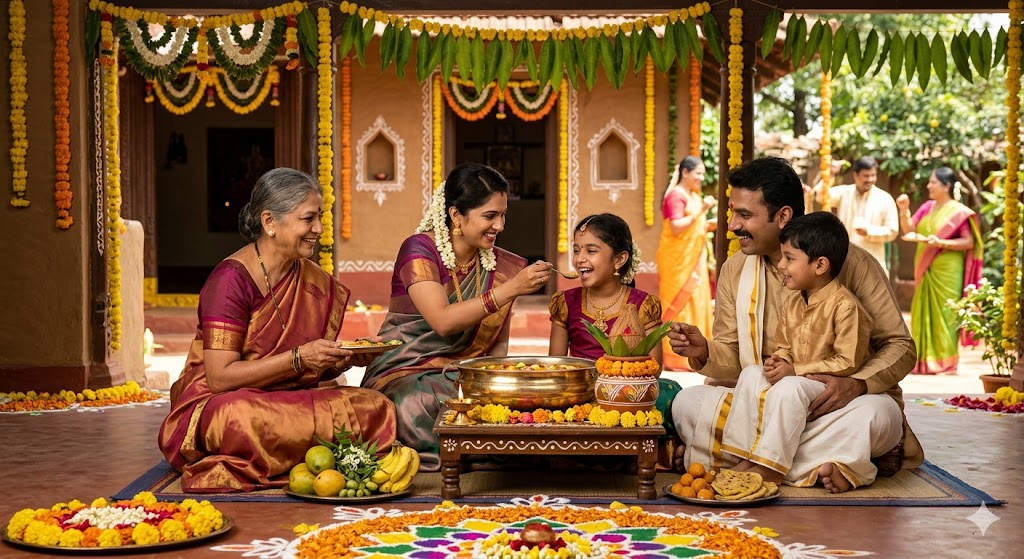
Ugadi, also lovingly known as Yugadi, marks not just a new day but the dawn of a new era. Celebrated with great zeal in Karnataka, Telangana, and Andhra Pradesh, and among Kannadiga and Telugu communities across the globe. Ugadi draws its name from the Sanskrit words ‘Yuga’ (meaning age) and ‘Adi’ (meaning beginning), symbolizing the start of a fresh year in the Hindu lunar calendar.
Interestingly, the same day is also observed as Gudi Padwa in Maharashtra, while in North India, it marks the beginning of Chaitra Navratri, nine days of devotion to Maa Shakti, fasting, and the ritualistic consumption of neem and mishri concoction as a symbolic cleanse.
Ugadi mornings begin with a sacred ritual. People rise before dawn, take a bath with neem water, wear new attire, and adorn their homes with fragrant strings of mango leaves and vibrant rangolis. The air is filled with the scent of incense and the chants of prayers as families gather to offer heartfelt gratitude to the divine and seek blessings for abundance and joy in the coming year.
No festival is complete without food, and Ugadi is no exception. Kitchens come alive with traditional dishes like Ugadi Pachadi, a symbolic chutney of Pan India’s various flavors—sweet, sour, bitter, spicy, and tangy, reminding us to embrace every shade of the coming year. These festive delicacies are lovingly shared among friends and family, reinforcing bonds and spreading joy.
Beyond the rituals, Ugadi is a time of vibrant cultural expression, street fairs, music, dance, and storytelling breathe life into the season. It’s a festival that seamlessly weaves tradition with celebration, reverence with joy, a true new beginning rooted in the spirit of harvest and hope.
Also Read: Gudi Padwa – The Festival of Victory
So, let’s get to know more about the Date, Rituals, and Significance of Ugadi 2026.
Ugadi 2026: Date, Muhurat, and Timings
This year, Ugadi will be observed on Friday, March 19, 2026
- Pratipada Tithi Starts: 9:22 p.m on March 18, 2026
- Pratipada Tithi Ends: 7:22 p.m on March 19, 2026
Find Out Date and Muhurat of Chaitra Navratri 2026
Significance of Ugadi
Ugadi holds greater significance for the people of South India. Ugadi holds greater significance in both seasonal and religious aspects. Let’s find out more in detail.
New Beginnings
Ugadi marks the beginning of a new year in the Hindu lunar calendar. It is believed that Lord Brahma, the creator of the universe, started the creation of the world on this day. Thus, Ugadi is considered an auspicious time for new beginnings, be it starting a new business or beginning a new phase of life.
Seasonal Change
Ugadi falls in the month of Chaitra, which usually marks the end of winter and the beginning of spring. The festival celebrates the changing seasons and the bounty of nature. The new year is welcomed with hope and optimism for a good harvest and a prosperous year ahead.
Religious Significance
Ugadi has religious significance for Hindus. It is believed that Lord Brahma created the universe on this day, and Lord Vishnu took his first incarnation as Matsya (fish) on this day to save the world from destruction. It is also believed that Lord Rama returned to Ayodhya after defeating Ravana on this day.
Community Spirit
Ugadi is a time for family and community gatherings. People exchange greetings, gifts, and traditional foods with their friends and loved ones. It strengthens social ties and fosters a sense of unity and togetherness.
Overall, Ugadi is a time of joy, hope, and new beginnings, and it holds great significance for the Hindu community.
Ugadi 2026 Festival Rituals
In the Deccan region of India, Ugadi is a time of merrymaking, colors, and enjoyment. Devotees start preparing for the festival of Ugadi almost a week in advance. Houses are cleaned and painted, and then decorated with rangolis and fresh flowers. Cow dung water is used to purify the ambience. Mango leaves are tied at the doorstep as a symbol of prosperity and good fortune.
- On a festive day, wake up early at dawn. Take a bath and wear clean clothes.
- Worship Lord Vishnu following the traditional rituals, offer prayers, and seek blessings for success and happiness in the coming year.
- On this occasion, people also buy new clothes and jewellery.
- This season is the time for raw mangoes. Thus, dishes made of raw mangoes like ‘pulihora and ‘bobbatlu’ are prepared during Ugadi.
- A traditional dish called ‘Ugadi pachchadi’ is also prepared on this day, which contains jaggery, green pepper, salt, neem flowers, tamarind, and raw mango pieces, which are symbolic of all the flavors of ‘life’.
- Ugadi is also a period of cultural activities. People gather together for devotional songs, hymns, and poetry recitals (kavi sammelan) to observe this festival.
- Also, the practice of ‘Panchanga Shravanam’ is carried out, where people gather together to listen to the Panchanga or the forecast of the New Year.
- This festival is also a time of family reunions. Families gather together to prepare a feast and enjoy this day.
- As goodwill of the new year, a special mixture made of neem leaves and jaggery is distributed among everyone.
- Seeking the blessing of the elders of the family is a must on this day, according to the ancient Indian tradition.
Legends Behind Ugadi
According to a legend associated with the festival of Ugadi, it is believed that Lord Brahma started the creation of this universe on this day. Thereafter, in order to keep track of time, he went on creating minutes, hours, days, weeks, and years. Hence, Ugadi marks the day of the creation of this universe.
Also, according to Hindu scriptures, Lord Vishnu is also known as Yugaakrit, which means the creator of Yugas or ages. Therefore, on this day of Ugadi, Devotees also worship Lord Vishnu and seek his blessings for a happy and prosperous life.
It is said that Ugadi is also the day when Lord Krishna left his human body and departed from this earth. Moreover, it is a well-known fact that Lord Rama returned to Ayodhya on Diwali after defeating King Ravana. And, on the day of Ugadi, he was crowned as the King of the Ayodhya Kingdom. His Rajyaabhishek was performed on the Ugadi day with great celebrations. Hence, this day is considered to be very auspicious and people start new ventures on this day.
Ugadi – Different Names in Different Regions of India
This festival day is celebrated as the beginning of a new year in different parts of India. Celebrated on the same day, Ugadi is known by different names in the various regions of the sub-continent of India.
- Navreh in Kashmir
- Thapna in Rajasthan
- Gudi Padwa in Maharashtra
- Samvatsar Padvo among Konkanis in Goa and Kerala
- Konkanis in Karnataka know it as Yugadi
- Sajubu Nongma Padwa in Manipur
- Chheti Chand among Sindhis
- Puthandu in Tamil Nadu
- Baisakhi in Punjab
- Chaitra Navratri begins from this day for North Indians
Also Read: Chheti Chand – The New Year of Sindhis