Ram Navami, one of the most auspicious festivals in the Hindu culture, marks the divine birth of Lord Shri Rama, known as the seventh incarnation of Lord Shri Vishnu. Celebrated with devotion and grandeur across India and by Hindu communities worldwide, the festival is not just about remembering the birth of a divine prince, but about reviving the eternal values of dharma, courage, love, and righteousness. For devotees, Rama Navami is both a spiritual reminder and a cultural celebration that unites families, communities, and temples in a wave of bhakti.
Ram Navami 2026: Date, Muhurat, and Timings
This year, Ram Navami will be observed on Thursday, March 26, 2026.
Rama Navami Madhyahna Muhurat: 11:32 a.m. to 01:59 p.m
Duration: 02 hours 27 mins
- Navami Tithi Starts: 11:48 a.m. on March 26, 2026
- Navami Tithi Ends – 10:06 a.m. on March 27, 2026
Find Out Date and Muhurat of Sita Navami 2026
Significance of Rama Navami
Ram Navami is not merely a celebration of Lord Shri Rama’s birth, but a remembrance of the victory of good over evil and the triumph of truth over falsehood. Lord Shri Rama is revered as Maryada Purushottam—the ideal man who upheld dharma in every aspect of life. His life story, immortalized in the epic Ramayana, continues to inspire values of humility, discipline, courage, compassion, and devotion. For devotees, observing fasts, reciting the Ramcharitmanas, and chanting the holy name of Rama bring inner peace and divine blessings.
Legendary Story Behind the Festive of Ram Navami
According to the scriptures, King Dasharatha of Ayodhya and his queens Kaushalya, Kaikeyi, and Sumitra performed the Putrakameshti Yagya to be blessed with children. From the sacred offering emerged a divine payasam, which was shared among the queens. Soon, Queen Kaushalya gave birth to Lord Rama, Queen Kaikeyi to Bharata, and Queen Sumitra to Lakshmana and Shatrughna. Lord Rama, born in the royal palace of Ayodhya, was destined to end the tyranny of demons and restore dharma on earth. His life’s journey—from vanvaas (exile) to slaying Ravana—is celebrated not just as mythology, but as eternal truth guiding mankind.
Rituals
- Morning and Midday Puja: Devotees wake up early, take a holy bath, and perform special pujas with flowers, incense, fruits, and bhajans. The midday worship is of prime importance as it coincides with Rama’s birth hour.
- Rama Katha and Ramcharitmanas Recitation: Temples and households echo with the chanting of Ramcharitmanas and bhajans glorifying Lord Rama.
- Fasting (Vrat): Many devotees observe a day-long fast, breaking it only after the puja with fruits or satvik food.
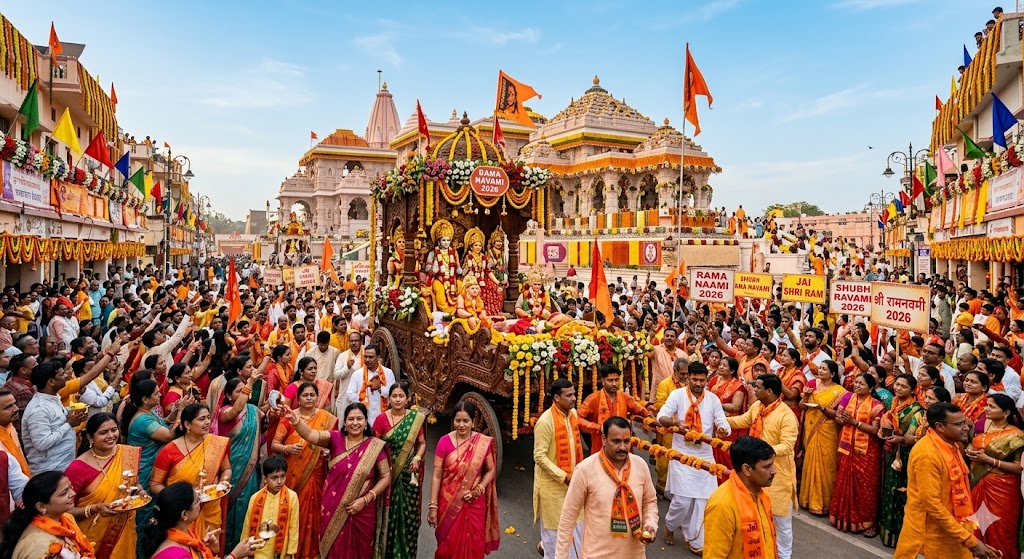
- Rath Yatras and Processions: In many regions, idols of Lord Rama, Sita, Lakshmana, and Shri Hanuman are taken out in decorated chariots, accompanied by singing and dancing devotees.
- Ayodhya Celebrations: The birthplace of Lord Rama—Ayodhya—becomes the epicenter of grand celebrations, with temples lit up, the Sarayu River ghats decorated, and lakhs of devotees gathering in devotion.
Conclusion
Rama Navami is more than a religious festival; it is a timeless reminder that righteousness and truth ultimately prevail. By remembering Lord Rama’s life, devotees are inspired to walk on the path of dharma and cultivate virtues of patience, integrity, and compassion. Whether celebrated in the temples of Ayodhya, the homes of South India, or among the diaspora abroad, Rama Navami continues to unite hearts in devotion, reminding us that Lord Rama’s ideals are as relevant today as they were in Treta Yuga.