Fourth Day of Navratri: Worship of Maa Kushmanda
The fourth day of Navratri is dedicated to Maa Kushmanda, the fourth form of Goddess Maa Durga among the Navdurga. Devotees worship this radiant manifestation of the divine mother to seek health, prosperity, and spiritual energy.
The name Kushmanda has deep spiritual meaning. The syllables Ku, Ushma, and Anda together symbolize the cosmic energy that created the universe. It is believed that Maa Kushmanda created the entire cosmos with her divine smile, bringing light and life into a universe that was once filled with darkness.
Because of this role in cosmic creation, she is revered as the source of all energy and the life force that sustains the universe.
Divine Form of Maa Kushmanda
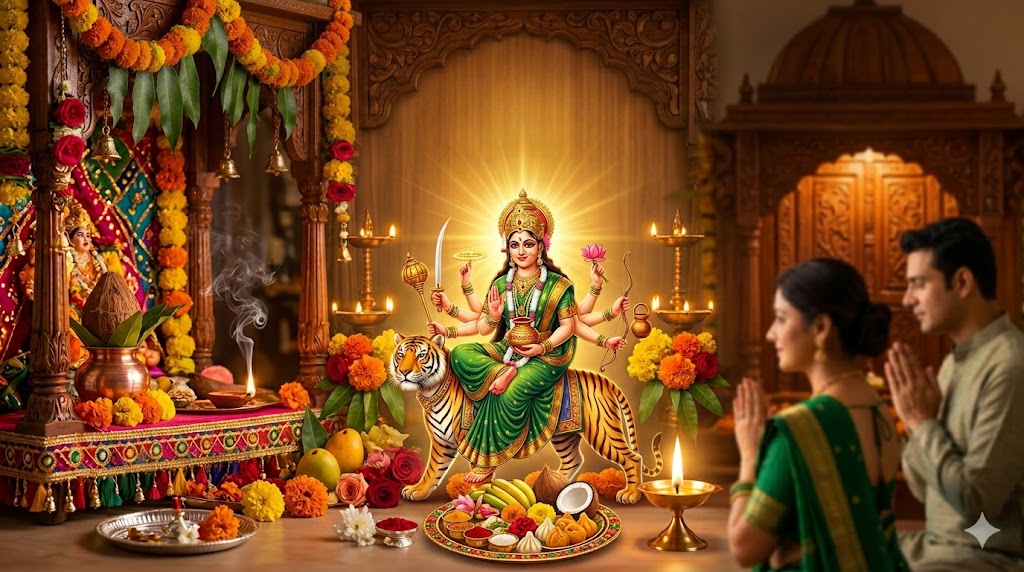
Maa Kushmanda is depicted as a glowing and powerful Goddess seated on a lion, symbolizing courage and divine authority. She is also known as Ashtabhuja Devi because she has eight arms.
Each of her hands holds sacred objects and weapons such as a lotus, bow, arrow, kamandal, chakra, mace, rosary, and a pot of nectar known as Amrit Kalash. These symbols represent spiritual power, protection, and abundance.
Her radiant form embodies the energy of the rising sun, and many traditions hold that she resides at the Sun’s core, spreading vitality and life across the universe.
Story Behind Maa Kushmanda
According to Hindu mythology, before the creation of the universe, there was darkness everywhere. There was no light, energy, or life.
At that moment, Maa Kushmanda appeared, and with a gentle smile, she illuminated the entire universe. Her divine smile created the cosmic egg, which led to the formation of planets, galaxies, and all living beings.
Because she brought light and life into existence, Maa Kushmanda is worshipped as the creator of the universe and the source of cosmic energy.
Her divine energy is also believed to power the Sun, making her an important symbol of vitality, warmth, and life.
Significance of Worshipping the Fourth Day of Navratri: Maa Kushmanda
The worship of Maa Kushmanda on the fourth day of Navratri is believed to bring strength, prosperity, and spiritual awakening.
Devotees believe that sincere prayers to Maa Kushmanda remove obstacles, negativity, and fear while filling life with positivity and energy. She is also associated with the Anahata Chakra, also known as the Heart Chakra, which represents love, compassion, and emotional balance.
Her blessings are believed to help devotees overcome difficulties, improve their health, and bring harmony into their lives.
Puja Vidhi for the Fourth Day of Navratri
Devotees wake up early during Brahma Muhurta and take a ritual bath before beginning the worship of Maa Kushmanda.
An idol or image of the Mother Goddess is placed on the altar, and a ghee lamp is lit. Devotees offer vermillion, flowers, incense, fruits, and sweets while chanting sacred mantras dedicated to the Mata.
Malpua is considered a special offering to Maa Kushmanda and is often presented as bhog during the puja. Devotees also recite Durga Chalisa and Durga Saptashati to seek divine blessings.
The puja concludes with aarti and distribution of prasad among family members and devotees.
Mantra of Maa Kushmanda
A commonly chanted mantra dedicated to Maa Kushmanda is:
ॐ देवी कूष्माण्डायै नमः।
Another prayer associated with the goddess is:
सुरासम्पूर्णकलशं रुधिराप्लुतमेव च।
दधाना हस्तपद्माभ्यां कूष्माण्डा शुभदास्तु मे॥
Chanting these mantras with devotion is believed to bring prosperity, protection, and spiritual growth.
Color of the Fourth Day of Navratri
The color associated with the fourth day of Navratri is yellow. This color represents joy, positivity, and energy.
Devotees often wear yellow clothes and offer yellow flowers to Mother Goddess during the puja to honor her radiant energy.
Blessings of Maa Kushmanda
Maa Kushmanda blesses her devotees with health, strength, and prosperity. Her worship is believed to remove negativity and fill life with divine energy and happiness.
Devotees pray to her for success, peace of mind, and protection from difficulties. Her presence reminds us that even the smallest spark of divine energy can illuminate the entire universe.
FAQs
Why is the fourth day of Navratri dedicated to Maa Kushmanda?
The fourth day of Navratri is dedicated to Maa Kushmanda because she represents the fourth form of Goddess Durga and is believed to be the creator of the universe.
What does the name Kushmanda mean?
The name Kushmanda comes from three words. Ku means little, Ushma means energy or warmth, and Anda means cosmic egg, symbolizing the creation of the universe.
What should be offered to Maa Kushmanda during puja?
Devotees commonly offer flowers, fruits, sweets, and malpua as bhog to Maa Kushmanda.
What is the mantra of Maa Kushmanda?
The commonly chanted mantra is
ॐ देवी कूष्माण्डायै नमः।
What blessings does Maa Kushmanda give?
She blesses devotees with health, prosperity, strength, and positive energy.