
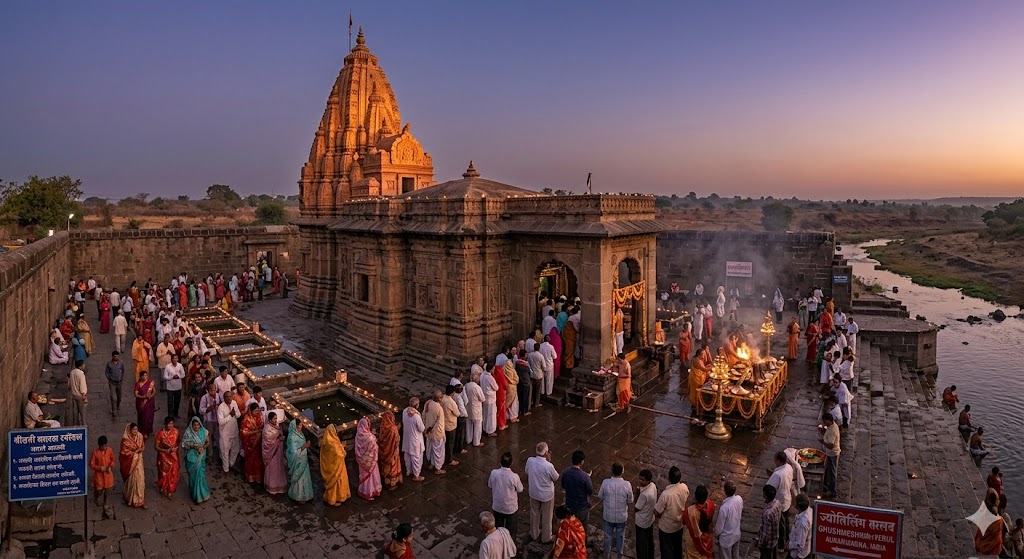
Ghushmeshwar Jyotirlinga – Everything You Need to Know
Ghusmeshwarnath Jyotirlinga is one of the 12 Jyotirlingas (sacred shrines of Lord Shiva) mentioned in Hindu mythology.
Shri Ghushmeshwar Jyotirlinga, revered as the twelfth and final Jyotirlinga of Lord Shiva, holds immense spiritual significance. Situated about eleven kilometres from Daulatabad in Maharashtra, this sacred shrine is also known as Shri Ghrishneshwar Jyotirlinga. However, there are differing views among scholars about its exact location — some believe that the Ghushmeshwar Jyotirlinga is situated in Shiwar village of Sawai Madhopur district in Rajasthan.
Devotees worship Shri Ghrishneshwar Mahadev with great devotion, as it is believed that sincere prayers here bless one with progeny and the prosperity of lineage. A grand celebration takes place every year during Mahashivaratri, attracting devotees from across the country who come to seek Lord Shiva’s divine blessings. The nearby Devagiri Mountain is adorned with beautifully sculpted idols of various deities, adding to the sanctity and charm of the place. Surrounded by scenic beauty and spiritual energy, Shri Ghushmeshwar Jyotirlinga stands as a magnificent symbol of faith and devotion to Lord Shiva.
Ghushmeshwar Jyotirlinga Temple History
According to Hindu mythology, the Ghusmeshwarnath Jyotirlinga temple has a rich and ancient history. It is said that the temple was built by Lord Krishna’s grandson, Vajranabha, who is also known as the founder of Mathura City.
The temple has a rich history and is associated with several dynasties and rulers who contributed to its growth and development. The temple has also withstood several invasions and attacks, a testament to its cultural and historical significance.
Various rulers and devotees, including the Chudasama dynasty of Gujarat, later expanded the Ghusmeshwarnath Jyotirlinga complex. They renovated the temple and added numerous structures, including a grand entrance gate, several smaller shrines, and a large pond known as the Laxmi Vilas Kund.
The temple also has historical significance as it was the site of several battles during the medieval period. The Mughal emperor Aurangzeb, who was known for his anti-Hindu policies, destroyed several Hindu temples during his reign. However, the Ghusmeshwarnath Jyotirlinga temple was one of the few temples that managed to survive his reign.
Today, the Ghusmeshwarnath Jyotirlinga temple remains an important pilgrimage site for devotees of Lord Shiva. The temple is managed by the Trust and attracts a large number of devotees from across India and around the world.
Significance of Ghusmeshwarnath Mandir
The Ghusmeshwarnath Jyotirlinga temple is considered a highly significant and revered site in Hindu mythology and is one of the 12 Jyotirlingas, which are believed to be the most sacred shrines of Lord Shiva. The temple is believed to be one of the most powerful forms of Lord Shiva. It is said that those who worship at this temple with great devotion and purity are granted blessings, protection, and salvation.
The temple has a rich and ancient history that dates back to Lord Krishna’s grandson, Vajranabha. It is believed that the temple complex was expanded by various rulers and devotees over time, making it an important site of cultural and architectural significance.
Ghusmeshwarnath temple is an important pilgrimage center for devotees of Lord Shiva, and it attracts large numbers of devotees during important festivals like Maha Shivaratri and Shravan Maas. The temple is also a symbol of the vibrant and enduring Hindu culture and is considered an important part of India’s cultural heritage.
The temple’s architecture is a classic example of traditional Hindu temple design, with intricate carvings and sculptures adorning the walls and ceilings. The temple’s grand entrance gate, smaller shrines, and large pond add to its architectural grandeur.
Overall, the Ghusmeshwarnath Jyotirlinga temple is an important site of spiritual, historical, cultural, and architectural significance, and is revered by devotees of Lord Shiva around the world.